Patna: The Bihar Assembly Elections of 2025, which concluded on November 11 with a record 66.91% voter turnout—the highest since 1951—have etched themselves as a defining moment in the state’s restless political journey. As counting day approaches on November 14, the atmosphere in Bihar is electric. The exit polls suggest a return to power for the ruling National Democratic Alliance (NDA) led by Chief Minister Nitish Kumar’s Janata Dal (United) and the Bharatiya Janata Party (BJP). Yet, behind this veneer of continuity simmers a far more complex reality—an election that has tested the foundations of Bihar’s democracy, challenged its political traditions, and exposed the deep fissures of caste, migration, and mistrust that continue to define its destiny.
The Historical Weight of Bihar’s Politics
To understand Bihar’s 2025 election, one must first trace the roots of its political evolution—a saga where caste and power have danced in lockstep. From its inception as a province in 1912, Bihar has been a crucible of social movements, caste revolts, and experiments in governance.

The 1952 elections, India’s first after independence, saw the Indian National Congress sweeping to power under Sri Krishna Sinha, a Bhumihar Brahmin, with Anugrah Narayan Sinha, a Rajput, as his deputy. The duo symbolized the dominance of upper-caste elites. But their rule also planted the seeds of resentment among marginalized groups, who would soon rise to demand their share of power.
By the 1960s, Bihar’s economic stagnation and widening inequalities fueled the rise of socialist icons like Karpoori Thakur, who in 1977 introduced 25% reservations for Other Backward Classes (OBCs). His decision reshaped Bihar’s politics permanently, empowering communities long excluded from power and setting off a caste-based reordering that still defines the state.
The 1967 elections proved pivotal. The Congress, though winning the most seats, failed to secure a majority, leading to the first non-Congress government under Mahamaya Prasad Sinha of the Jana Kranti Dal—a coalition of socialists, Jan Sangh (the BJP’s precursor), and communists. The coalition’s collapse within a year inaugurated a decade of political instability: eight Chief Ministers between 1967 and 1977.
When Indira Gandhi’s Emergency (1975–77) throttled democracy, Bihar became the epicenter of resistance. Jayaprakash Narayan’s “Total Revolution” ignited student movements against corruption, eventually toppling Indira’s regime. The Janata Party briefly ruled but disintegrated under the weight of internal contradictions, plunging Bihar back into a cycle of coalition collapses and President’s Rule.
The Lalu Era: Mandal, MY Politics, and “Jungle Raj”
The 1990s brought the most transformative—and controversial—figure in Bihar’s modern history: Lalu Prasad Yadav. Harnessing the Mandal Commission’s wave of OBC assertion, Lalu positioned himself as the messiah of the Yadav–Muslim (MY) alliance. His slogan “Bhura baal saaf karo” (wipe out upper-caste dominance) captured the populist fervor of the time.
Under the Rashtriya Janata Dal (RJD) banner, Lalu’s regime (1990–2005) redefined Bihar’s social order but at a heavy economic and governance cost. While marginalized castes tasted political empowerment, the state plunged into lawlessness and corruption—the notorious “fodder scam” being emblematic. As crime soared and infrastructure crumbled, Bihar’s per capita income fell to the nation’s lowest.
By 2005, public patience had snapped. The February polls delivered a hung assembly, forcing a repoll in October, where Nitish Kumar’s NDA triumphed with 143 seats, ending RJD’s 15-year reign. Nitish, a Kurmi OBC, ushered in the era of “Sushasan” (good governance)—building roads, curbing crime, and promoting education, especially for women. Yet, Bihar’s curse of unstable alliances would persist, as Nitish’s political allegiances became as fluid as the Ganga.
The Flip-Flop Decade: Nitish Kumar’s Political Tightrope
Between 2013 and 2025, Nitish Kumar’s political somersaults have become legendary. In 2015, he joined hands with Lalu Prasad Yadav in the Mahagathbandhan (MGB), securing 178 seats and reclaiming the Chief Minister’s post. Two years later, he split again, citing corruption in RJD, and rejoined the BJP-led NDA.
The 2020 elections were a near-photo finish—NDA secured 125 seats against MGB’s 110—but Nitish’s shrinking JD(U) presence (down to 43) exposed his waning grip. Then, in January 2024, he stunned everyone by briefly switching to the MGB once more, only to return to the NDA within hours, marking his ninth oath-taking as CM. His nickname “Paltu Ram” became both a taunt and a testament to his survival instinct.
This chronic instability underscores a fact: no single party has won a solo majority in Bihar since 1985. On average, governments last less than three years.
2025: A Battle Beyond Ballots
The 2025 election—held in two phases on November 6 and 11—was as much a political battle as a social reckoning. The campaign was marred by bitter controversies, chief among them the Election Commission’s Special Intensive Revision (SIR) of electoral rolls in June.
The ECI claimed it was purging 50 lakh fake or duplicate voters. The opposition, led by Tejashwi Yadav and Rahul Gandhi, accused it of targeting Muslims, migrants, and women voters, particularly in Seemanchal’s minority districts, where voter deletions reportedly touched 20%.
Rahul’s “Voter Adhikar Yatra” in August accused the NDA of “vote chori” (vote theft), demanding 100% EVM-VVPAT verification. Tejashwi alleged even his voter ID was falsified—an accusation debunked by the ECI but politically explosive. While BJP defended the exercise as a clean-up to ensure fair voting, the episode deepened the mistrust that has long haunted Bihar’s electoral machinery.
Campaign Carnival: Rallies, Rhetoric, and Rivalries
From the October 6 notification to the November 9 finale, Bihar turned into a theater of political theatre.
Prime Minister Narendra Modi headlined 20 rallies, invoking the dream of a “Viksit Bihar” (Developed Bihar) and announcing schemes promising 2.5 crore jobs. The BJP’s campaign leaned on women—who recorded a historic 71.6% turnout, outpacing men’s 62.8%—as the party highlighted Nitish’s liquor prohibition and cycle-for-girls programs as symbols of empowerment.
In Seemanchal, Amit Shah sharpened the Hindutva narrative, vowing to drive out “infiltrators,” while Yogi Adityanath invoked the Ram Temple to stir cultural pride.
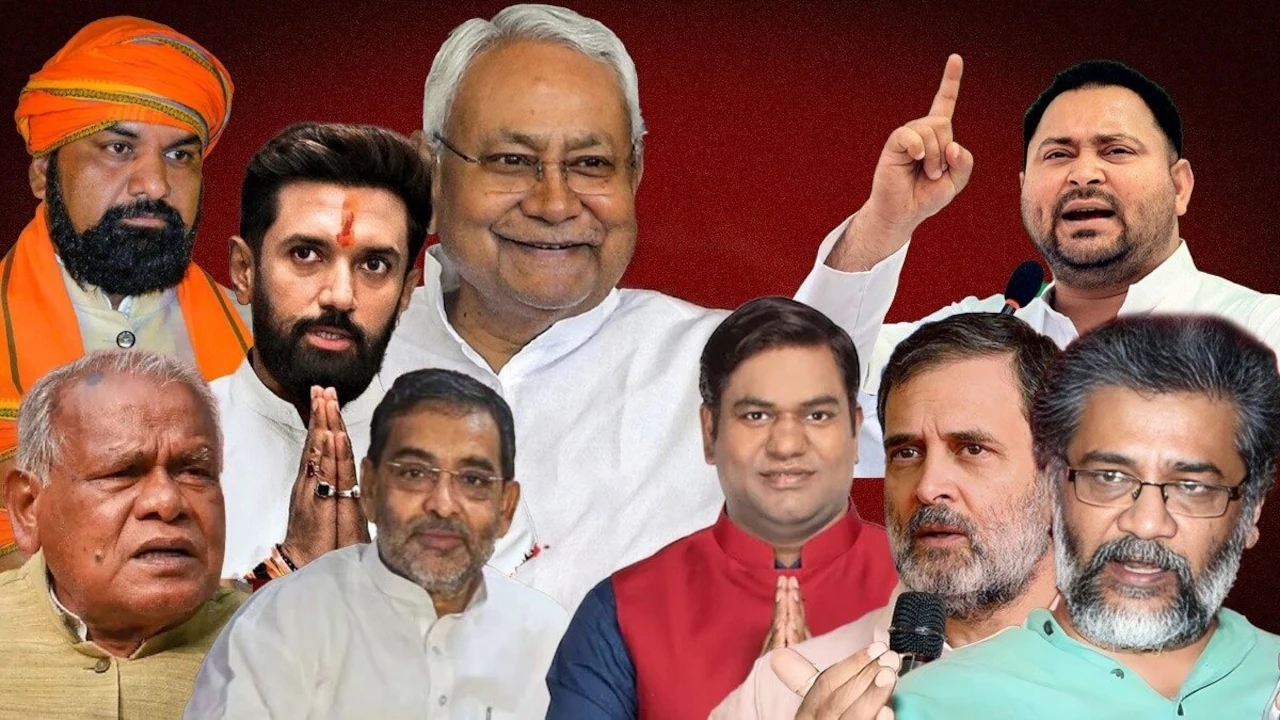
The NDA’s seat-sharing reflected new power equations: JD(U) and BJP split the lion’s share equally at 121 seats each, while Chirag Paswan’s Lok Janshakti Party (Ram Vilas) contested 40 seats, targeting the Paswan (Dalit) vote bank.
Meanwhile, the Mahagathbandhan, rebranded locally as the INDIA bloc, campaigned on a social justice and employment plank. Tejashwi Yadav, just 36, promised 10 lakh government jobs, free electricity, and a statewide caste census. His slogan—“Naukri aur Nyaay” (Jobs and Justice)—resonated deeply with the youth and migrants.
Rahul Gandhi, addressing packed rallies in Patna and Bhagalpur, tore into the BJP-RSS “divisive machinery.” Yet Congress, despite fielding Kanhaiya Kumar from Begusarai, was projected to win barely 20 seats.

The Left, particularly CPI(M) and CPI, added ideological depth but struggled with internal fissures. Smaller allies like Mukesh Sahni’s VIP felt shortchanged in ticket distribution, fueling speculation of NDA poaching—rumors that fizzled out as “psy-ops.”
The Wildcard: Prashant Kishor’s Jan Suraaj
Perhaps the biggest wildcard this election was Prashant Kishor’s Jan Suraaj Party (JSP). Once a political strategist for Modi, Nitish, and Mamata Banerjee, Kishor’s 2022 padyatra across Bihar had raised hopes of a third alternative.
JSP fielded candidates in all 243 constituencies, focusing on education, healthcare, and corruption-free governance. Kishor targeted the youth—35% of Bihar’s electorate is under 30—and slammed both Nitish and Tejashwi as relics of “old politics.”
However, his message failed to break through the entrenched caste loyalties and limited funding. As one political observer quipped, “Bihar’s voters want change—but not from outsiders without caste anchors.”
Flashpoints and Faultlines
The poll season wasn’t without its violence. The murder of gangster Dular Chand Yadav in Mokama, an attack on Deputy CM Vijay Sinha in Lakhisarai, and sporadic EVM tampering allegations in Ara kept tensions high.
Despite the noise, the Election Commission boasted a clean record—zero repolls across two phases. But the opposition alleged that special trains ferrying migrant voters from Gujarat and Maharashtra on polling eve were part of “vote management.”
On social media, memes and misinformation competed with manifestos. “Gen Z voters,” analysts noted, “were as likely to express politics through reels as through ballots.”
The Verdict’s Waiting Room
As the exit polls rolled out after 6:30 PM on November 11, the numbers told a familiar story—though with new undertones.
- Axis My India predicted NDA: 121–141 seats (43% vote share), MGB: 98–118 (41%), JSP: 0–2 (4%).
- Matrize gave the NDA a 147–167 seat sweep.
- Today’s Chanakya projected 160±12.
- NDTV’s Poll of Polls placed NDA at 146, MGB at 92, and JSP as a marginal player.
Analysts noted a gender divide: women tilted decisively toward NDA (45%), while youth favored Tejashwi (34% preferred him as CM vs. 22% for Nitish).
The Caste Conundrum
At the heart of Bihar’s election lies the eternal variable: caste. The OBCs (51%) and Extremely Backward Classes (EBCs, 36%) remain Nitish’s backbone, bolstered by the state’s caste survey affirming their numerical dominance. The upper castes (15%), traditionally BJP loyalists, are the alliance’s ideological anchor.
But the Muslim-Yadav (MY) combine, still potent in over 70 constituencies, gives Tejashwi Yadav a formidable base. The Paswans and Dalits, fragmented between LJP(RV) and MGB, could decide at least 30 seats.
Caste arithmetic, as always in Bihar, is destiny disguised as democracy.
Beyond Numbers: The Meaning of 2025
If the exit polls hold, Nitish Kumar is set to return for an unprecedented tenth term—cementing his reputation as India’s most durable political survivor. Yet, BJP’s equal seat share hints at an impending power shift. Insiders whisper that Samrat Choudhary, the BJP state chief, could be the NDA’s long-term face in Bihar.
For Tejashwi Yadav, a strong showing—even in defeat—could catapult him into national prominence as the INDIA bloc’s youth icon. His call for a caste census, now mainstreamed, may reshape social justice politics across India.
For Prashant Kishor, the election serves as a humbling lesson that Bihar’s voters, while yearning for reform, remain bound by identity, not ideology.
A Test of Democracy Itself
The 2025 Bihar election is more than a contest of parties—it is a referendum on trust. Trust in institutions after the voter roll controversy. Trust in leadership after decades of defections. Trust in democracy after years of despair.
A record turnout often signals change—five times in Bihar’s history, high participation preceded political upheaval. Yet, this time, Nitish’s coalition may defy that pattern through careful caste engineering and welfare outreach.
Still, as ballots turn into verdicts across 46 counting centers, one truth endures: Bihar never votes for complacency. Whether through revolution, rebellion, or renewal, its people have always demanded reckoning.
In this land that birthed Jayaprakash Narayan’s revolution and Lalu’s social justice, 2025’s message is clear—Bihar votes not just for leaders, but for a future untainted by “jungle raj” or “vote chori.”
The results on November 14 will decide more than who governs. They will reveal whether Bihar’s democracy, battered but unbroken, can finally rise above the ghosts of its past—and script a chapter of change that lasts.












 https://www.youtube.com/watch?si=RtToJsBhYBatUrym&v=mOuYNSdhjHA&feature=youtu.be